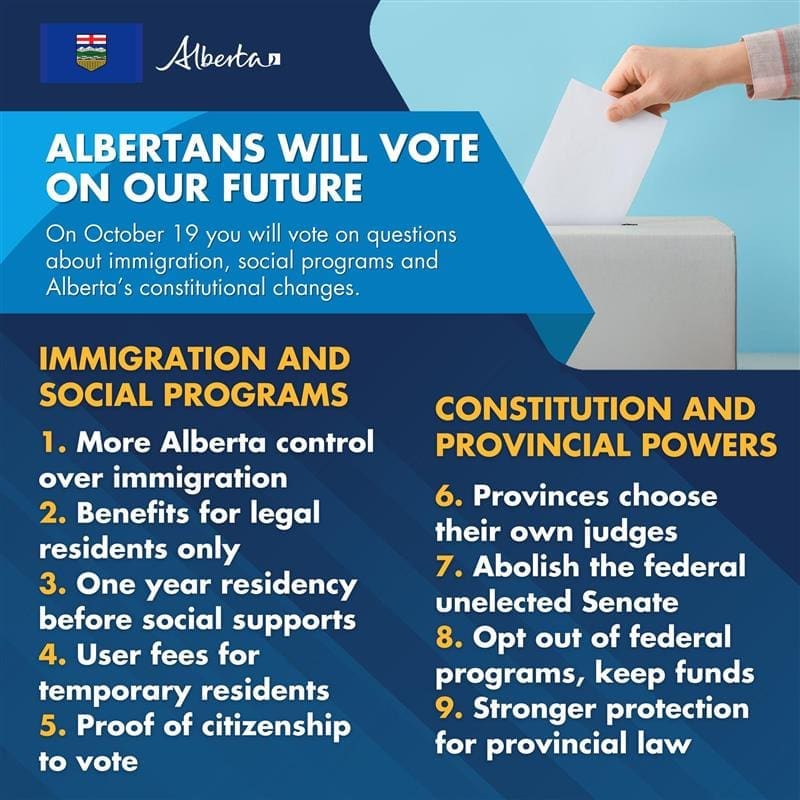
The Alberta government, through Premier Danielle Smith, recently announced a provincial referendum scheduled this fall. On Oct. 19, Albertans will be asked to vote on a range of government policy topics. Critics have referred to this as an “anti-immigrant” referendum, mainly because of how five of the questions were phrased.
As a non-permanent resident in Canada, of particular relevance to me are three of those questions that talk about removing or placing additional requirements to benefits currently enjoyed by those like myself.
- “Do you support the Government of Alberta introducing a law mandating that only Canadian citizens, permanent residents and individuals with an Alberta-approved immigration status will be eligible for provincially-funded programs, such as health care, education and other social services?”
- “Assuming that all Canadian citizens and permanent residents continue to qualify for social support programs as they do now, do you support the Government of Alberta introducing a law requiring all individuals with a non-permanent legal immigration status to reside in Alberta for at least 12 months before qualifying for any provincially-funded social support programs?”
- “Assuming that all Canadian citizens and permanent residents continue to qualify for public health care and education as they do now, do you support the Government of Alberta charging a reasonable fee or premium to individuals with a non-permanent immigration status living in Alberta for their and their family’s use of the healthcare and education systems?”
Immigration has been a hot topic in Canada for a while now. As someone who is interested in settling down in Edmonton permanently, I am always concerned about politically driven policy proposals that appear to affect the viability of Alberta (and by extension, Canada) as an immigration destination for myself and my wife.
I have no problem with the federal government decreasing immigration rates to more sustainable levels. I also have no issues with Alberta prioritizing Albertans for employment opportunities within the province. My own country has similar policies, and I can’t see why I should begrudge Canada and Alberta from implementing the same thing. It makes no sense to encourage people from outside of Canada to fill job vacancies in a province with an unemployment rate of almost 8 per cent. Nor does it make sense to accept immigrants at numbers that simply can not be supported by existing social services.
What I find problematic is the apparent flip-flopping of Alberta on the very topic of immigration.
A shifting message from the provincial government
As recently as March 2024, Smith publicly called on then-Prime Minister Justin Trudeau to double Alberta’s Provincial Nomination Program (PNP) allotment from 9,750 spots to 20,000. She also urged Trudeau to accept 10,000 more Ukrainian refugees. At that time, Smith viewed the PNP allotment limitation as Ottawa interfering with Alberta’s economic development. After sharing details of Alberta’s labour market and forecasted shortages, the letter specifically says that “immigration is critical to addressing these labour challenges.”
Just six months later, Smith was singing a different tune.
In a Sept. 2024 televised address, she blamed high immigration levels for practically every difficulty that Alberta was experiencing, such as the rising cost of living, disruption in social services as well the stresses on the province’s housing and employment situation. She went on to describe the federal government’s immigration policy as “unrestrained.”

But during the same time period, the federal government began to introduce stricter rules designed to decrease the numbers of those who were immigrating through the study permit pathway. Perhaps the increase in immigration to Alberta can be attributed to other factors such as interprovincial migration, something beyond Ottawa’s control and notably something that Smith’s United Conservative Party (UCP) actively encouraged prior to her term as premier.
In Smith’s address to announce the fall referendum, she implied a desire to prioritize economic migration above all other kinds of immigration pathways. But given the inconsistency shown by her government on immigration and the apparent low regard it has for temporary foreign workers, this does not paint an encouraging picture for the economic migrants that she desires.
If the government itself appears to have no idea of the economic potential of the immigrants they claim to want, it results in an environment that is not conducive for people to make a serious contribution towards the province’s development.
Note that 85 per cent of the people that receive Alberta PNP nominations are temporary foreign workers within Alberta. So for all intents and purposes, temporary foreign workers and economic migrants are practically the same group of people.
Stability a missing piece for economic drivers
One thing that encourages immigration is stability — stability in income, status and social support. To a certain extent, Alberta has the choice to create and impose its own policies as it sees fit. But if these policies go in one direction now and another direction the following year, or if the government itself appears to have no idea of the economic potential of the immigrants they claim to want, it results in an environment that is not conducive for people to make a serious contribution towards the province’s development.
Immigrants have different reasons to choose Alberta over all other provinces. For me, the main reason was that the province appeared to have the best potential for growth and I was confident I had the skills to make a significant contribution to that. I am unlikely to change my mind about this, despite Smith’s flip-flopping. I have enough resources and sources of support to remain in Alberta (at least for the next three years).
But the economic drivers who do not have the same privilege — and I know there are many — are more likely to look for opportunities in other provinces where they will be more valued and enjoy more stability. The assurance that one will have long term Alberta Health coverage can determine their decision. And Alberta is facing a labour shortage in the trades, where immigrants are underrepresented. So, does the Alberta government want economic migrants to stay or go?
Feature graphic by Amy St. Amand with files from YourAlberta (Government of Alberta) / YouTube