NAIT might get an Applied Artificial Intelligence Diploma. The full-time, two-year program was first brought to Academic Council before being approved by the Board of Governors.
NAIT currently has a continuing education course, AI-Driven Project Management, but the proposed diploma would be a full-time two-year program.
The program proposal isn’t fully approved — it still needs approval from the Government of Alberta before NAIT can comment on it, they told the Nugget.
Instead, I talked to NAIT students, grads and industry professionals to ask what their opinions are and what outcomes they’d want from a course like this.
What NAIT students think about AI
Ronan Leister, a first-year Business Administration student, thinks it’s a good thing.
“I think the world’s evolving,” he says.
According to the program proposal obtained by the Nugget, 70 students and grads from NAIT’s School of Media and Information Technology were surveyed about the proposed diploma, and “results demonstrated clear alignment” between student needs and an Applied AI program.
Leister agrees. “AI has been becoming much more vital in today’s society, and I think if people understand how to use it better … there’s not really a harm in that,” Leister says.
In my experience, I think people are generally adopting this opinion. But ethical concerns surround the use of AI. Some students, like Leister, say it can help “quicken research” or make studying faster, but think “it can be dangerous if we rely on it too much.”
“As long as we’re not using it to cheat or beat the system as to not actually doing the work, but just making AI do it for us,” Leister explains.
Learning how to curb unethical behaviour, or even detect it, could be useful. In the proposal from Oct. 20 Academic Council Package, there is mention of “Introduction to AI and Ethics” course. But my interest is more about the career and application outcomes of such a diploma.

Career outcomes are most important for an AI diploma at NAIT
Aaron Kennedy, a NAIT graduate of the now paused Wireless Systems Technology diploma, says there are lots of applications for AI in his field.
“The sort of basic programming, like say, ‘Let’s just clean up this small data set for some invoicing.’ Writing a script to do such a thing would have taken paying a pro, would have probably taken me contracting it out to a proper programmer or taking me weeks to do and I can write basic scripts in five minutes now.”
He says he predicts people running “into situations where they’ve built a lot of complexity that they don’t understand.”
Maybe this is where Applied AI could be useful.
“There’s a small portion of my job that I feel the tooling has given me superpowers to do.”
But he doesn’t think someone with a two-year AI diploma could replace his job.
“A large part of that is the customer interaction portion of coming from a small business world. Sure, somebody could replace the programming that I do at my job, but I’m not a programmer.”
“There’s a small portion of my job that I feel the tooling has given me superpowers to do,” Kennedy says. But he reiterates how important customer satisfaction and interaction is.
“Everybody hates when people put AI in charge of their customer service.”
Nico Schiavone, a University of Alberta Bachelor of Science alumnus and current computer science graduate student at the University of Toronto, agrees. “A lot of people like the human touch,” he says.
Schiavone is studying multi-agent systems and reinforcement learning and large language models. He recently interned at Microsoft Copilot and will return to work there permanently in March.

To clarify, he works and learns more on the development side of AI. At his level, he would expect that the two-year diploma would be a comparison to a “course-based computer science master’s degree” that you would take after a four-year degree.
“I don’t think two years is enough if you’re coming out of high school,” he says.
While Schiavone says it’s common for employers in his industry to require specialized technical training, the training on its own might not be enough to land a job.
He explains that the competition for low-level positions in the industry is already high for degree holders and even master’s degree holders.
“If you only have a two-year [diploma] without a bachelor’s degree in this already highly overqualified market where you have a ton of people who don’t [care] about computer science [degree holders] trying to get these jobs, there’s better ways for you to show your commitments or for you to show your skills.”
The Applied AI diploma program proposal states that while a mathematics or computer science background would be “beneficial,” it is not mandatory.
“The program is designed for recent high school graduates, career changers, working professionals looking to upskill or reskill, as well as entrepreneurs and innovators,” says the proposal document.
Schiavone’s perspective speaks to my uncertainty of an Applied AI diploma.
Are there jobs there for those without any former experience or education in AI besides the proposed diploma? The diploma emphasizes Applied Artificial Intelligence, but as Kennedy pointed out earlier, he was able to quickly deploy AI himself.
“Everybody hates when people put AI in charge of their customer service.”
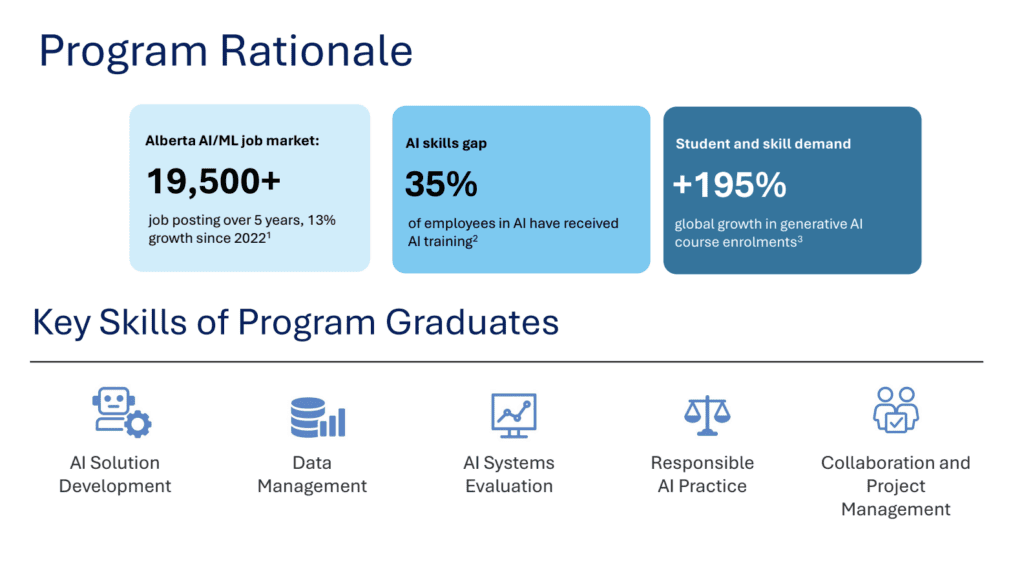
But in NAIT’s Oct. Academic Council package, they report that “there is an expected imbalance of over 1000 more job openings than job seekers in software development and over 1300 more data analyst jobs than job seekers” in 2026.
“A significant number of companies are adopting AI, yet only 35% of their employees have received AI training,” the proposal says, citing a 2024 article from the recruitment company Randstad.
Application of NAIT Applied AI diploma is key
I think credibility and differentiation for this diploma is key.
The Work Integrated Learning, industry partnerships and institutional collaborations and pathways components in the program proposal are the critical ones for me — and Schiavone agrees.
“What I would be looking for is something to differentiate it from that course-based degree, like mandatory work experience component, or perhaps something to connect you with industry, given the reputation it made,” says Schiavone.
Students need to be directly and clearly connected with the industry if they want to hedge out other institutions’ computer science degrees and graduate programs.
If that part isn’t visible and successful, I have my doubts about the viability of the diploma.
Editor’s note: This article was originally published in our March 2026 print issue. Read it here.
Feature image via NAIT