Being a leading immigration destination, Canada hosts many peoples from around the world that are part of a diaspora, and this is seen in the NAIT community’s diversity.
NAIT encourages these diasporic communities to value their cultural ties to their home countries through events like Heritage Fest and Black History Month.
One diasporic community with a visible representation among NAIT students and staff is the Yoruba people of Nigeria.
During the Living Library series in February, Latifat Busari, an academic and career advisor with the Career Services office, spoke about the history and current realities faced by the Yoruba people in Nigeria and around the world.
Busari, who uses they/she pronouns, emphasized at the beginning of their talk that the Yoruba are just one of 500 ethnolinguistic groups in Nigeria. Like many people in Africa, the Yoruba struggled and suffered under colonialism.
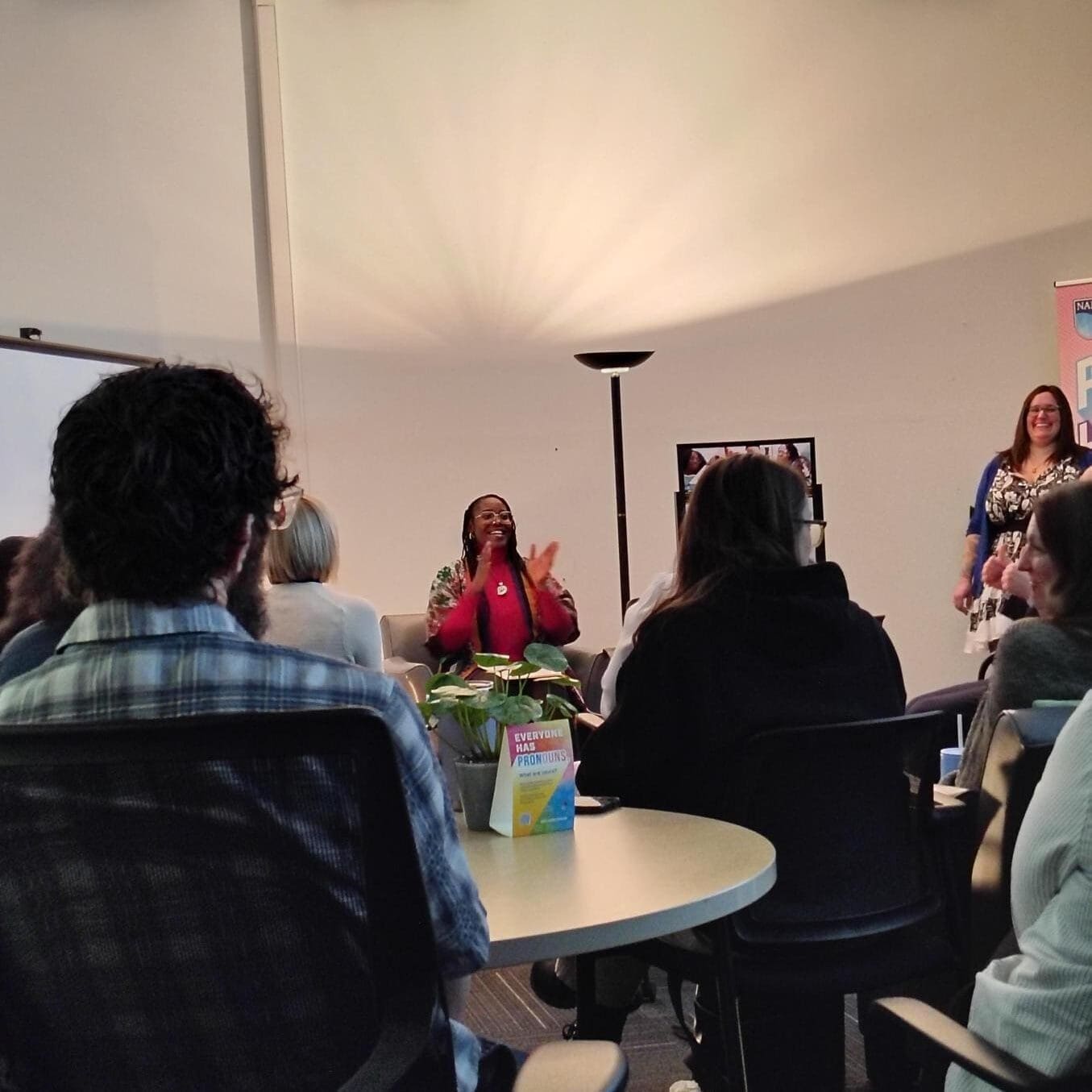
Now, living in Canada, Busari’s identity as a Yoruba descendant is an important aspect of their art, storytelling and even how they present themself at NAIT.
Dealing with forced influences
Busari revealed that an ongoing difficulty in promoting indigenous Yoruba culture within Nigeria and in the diaspora is how most of what is written about them is seen through the lens of Islamic, Christian and European influences through colonialism. This is because the Yoruba traditionally relied on oral tradition rather than written records to ensure that the community’s collective history and heritage was passed on to later generations.
“They kept a very crucial part of themselves alive and they kept passing that on to future generations.”
But when Islam and Christianity arrived, they brought with them the Arabic script and the Latin alphabet. As literacy became widespread, marginalization and cultural biases against the polytheistic Yoruba indigenous religion made its way to Nigeria’s written history, making it challenging to find cultural information untainted by these same biases.
However, one positive thing Busari shared was the seemingly tolerant approach of Yoruba Muslims and Christians towards each other.
“I was raised by both influences, and I think a lot of people who are Yoruba are too, to some extent,” says Busari. They explained that their father was Christian and their mother is Muslim, so they experienced interactions within both communities. “There’s a lot of us that live in those intersections where we have a blended family.”
They also shared stories of Christians attending Muslim rituals and celebrations, and vice versa. “It wasn’t because it was a religious thing. It was because it’s a spiritual aspect in a communal experience and they wanted to be a part of it,” Busari says.
This may be surprising for people who come from fundamentalist or puritanical backgrounds, where religions tend to be less tolerant of its members joining the rituals and celebrations of others.
But that wasn’t Busari’s experience. “Even though the fundamentalist idea still exists [among Yoruba Christians and Muslims] … I think for my tribe specifically, there’s more opportunities for a communal cultural experience.”
Interactions with other diasporic communities
Busari also shared how Yoruba communities outside of Nigeria, particularly those in Brazil and the Caribbean, appear to celebrate Yoruba culture at a grander scale compared to communities within Nigeria. This, unfortunately, is explained by a painful period of African history.
An early contributor to the Yoruba diaspora is the transatlantic slave trade. Today, countries like Brazil, Cuba and Jamaica have significant Yoruba populations as a result of forced migration. Within these new diasporic communities, Yoruba traditions blended with local influences through a process known as syncretism. But Busari says they still treated their indigenous beliefs as an integral part of their shared identity.
“The people who were unfortunately enslaved and transported, they still had a strong culture to their indigenous identity despite the horrible things they had to go through,” Busari explains. “They kept a very crucial part of themselves alive and they kept passing that on to future generations.”
Busari further explains that while the enslaved Yoruba suffered greatly, they did not undergo the same systemic religious and colonial assimilation as those who remained in their homeland.
“We had to … embed ourselves in [European colonial] structure, which meant forgetting everything about us. And so in that forgetting, religion was used as a tool.”
Busari looks to these diasporic communities as a source of inspiration for the Yoruba in Nigeria when it comes to having pride for one’s indigenous culture. The communities, even through syncretism, are still a source of cultural information that might have been collectively forgotten.
Becoming more of oneself outside of one’s homeland
Busari regards their own identity as an intersection of being African, Yoruba and queer. They shared about initially experiencing cultural shock in Canada because of workspaces where “you’re only allowed to be in one specific way and it’s usually a way that is geared towards whiteness.”
During their Living Library talk, Busari said the environment at NAIT allows them to be more of themself.

“It’s very refreshing to see that the diversity of our identities are not just acknowledged. They’re allowed to exist and take up space,” they explained in a later interview with the Nugget.
This act of letting other cultures take up space is an important indicator that an organization’s diversity policy is not merely performative. The practice of “diversity washing,” where companies use diversity to improve their public image but do not follow through with their proposed values, is an unfortunate reality in many workplaces.
For Busari and many others at NAIT, the intersections of the different aspects of identity require space for expression and growth. This is not possible when diversity is treated as something tolerated but limited — when people are more concerned about not crossing cultural boundaries instead of authentic self-expression.
“It wasn’t because it was a religious thing. It was because it’s a spiritual aspect in a communal experience and they wanted to be a part of it.”
Sharing religious and cultural experiences, even without adhering to a specific identity, can be a meaningful, and even beautiful, practice when approached with care, respect and a desire to learn.
As Busari says, “the environment at NAIT allows for diversity to exist without shrinking itself.”
With all the changes NAIT is undergoing now, we hope that at least this aspect stays the same.
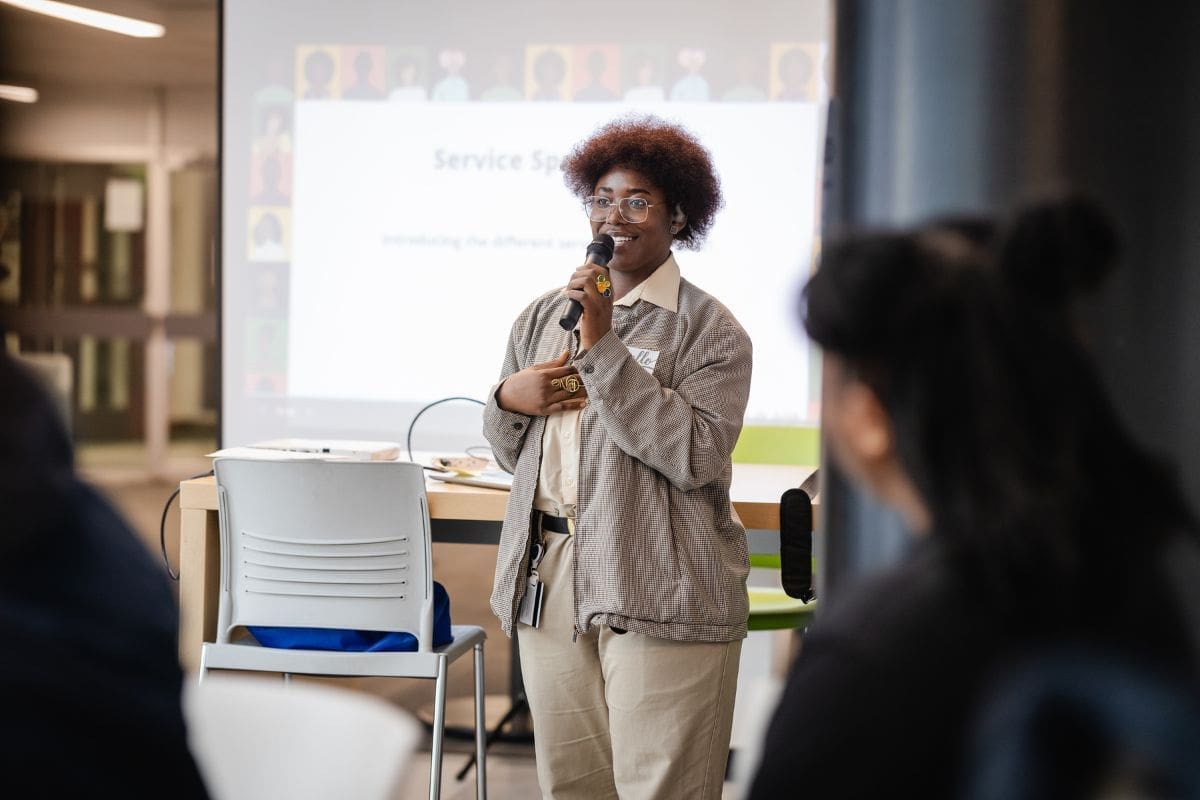
Feature image: Busari speaks at the Black, Caribbean and African student orientation in January. Photo by Nino Aguilar/The Nugget