For some business students currently within online classes at NAIT, final exams will now require students to complete the exam in person or at pre-approved proctoring sites. This arrangement presents itself, reasonably enough, as a measure intended to ensure final exam consistency and protect academic integrity.
It seems uncomplicated. Do not cheat. Do not plagiarize. Do not misrepresent your work. Follow the rules and there is, presumably, nothing more to discuss.
But for students, an online class is an arrangement typically in arrangement for convenience. It allows a student to fit an education around life, work, family, distance or difficulty commuting. Once an exam requires the student to appear at a particular place at a particular time, that convenience becomes conditional. When academic integrity is an issue but students want convenience, is a change like this worth it?
Preliminary action amidst academic misconduct fears
Students back for this fall semester at NAIT may have been aware of the recent “Fundamentals and Responsible Use of AI” course added to Brightspace which outlines how and how not to use AI for academic purposes. Upon scrolling through the modules, I was hit with the feeling that NAIT is potentially preparing for more cases of academic misconduct related to AI.
CBC published an article last year called “Canadian Universities grapple with evaluating students amid AI cheating fears.” The article claims post-secondary institutions across the country are bracing for more cases of academic misconduct with the rise of AI and continued use of technology during exams.
There is a tendency among peers of mine, and admittedly myself, to regard academic misconduct as an issue of little importance, something that happens to someone else.
It seems uncomplicated. Do not cheat. Do not plagiarize. Do not misrepresent your work. Follow the rules and there is, presumably, nothing more to discuss.
The ability to study remotely has posed a huge advantage not just for students, but for the institution as well.
It is an “out of sight, out of mind” kind of problem. “Out of sight, out of mind” was the mindset some online students may have had when they could take final exams from home. No longer is this always the case, and no longer is this an “out of sight, out of mind” issue.
A distinction between online learning and online examination
Though taking final exams online is convenient, I must remind myself that there is a difference between online learning and online exams. For learning, the ability to study remotely has posed a huge advantage not just for students, but for the institution as well.
However, these same opportunities also pose disadvantages. Integrity with online examinations is more at risk than it otherwise would be with in-person examinations, especially when exams taken remotely only have so much as a downloadable proctoring software to prevent misconduct.
Does this mean exams should be different for different circumstances? Or should everyone be examined the same?
Separating and knowing the difference between learning opportunities and examinations is vital here. Learning opportunities are not going anywhere. Students can still study remotely. On top of this, students will be made aware of these exams during the first days of classes, giving more than adequate time to plan.
All things equal?
Edmonton is a city under construction. As I write this, I am travelling the Yellowhead Highway via Spruce Grove’s 560 commuter bus. Commuting is a long and difficult task for anyone who does not live immediately next to campus.

I personally must plan an hour and a half in advance to guarantee my arrival is on time. I am no stranger to the circumstances which might drive a student to pursue an online education. I am no stranger to circumstances more difficult than even my own — circumstances of which may make attending in-person a difficult task, even if limited only to final exams.
Does this mean exams should be different for different circumstances? Or should everyone be examined the same? In my experience, online proctoring software only adds stress to what is an already stressful experience. But also in my experience, in-person exams remove that stress so I can focus on the task at hand. If one method creates more potential for academic misconduct, and one does not, should both methods be implemented?
If some students are exploiting the convenience of online final exams while others uphold academic integrity, perhaps this issue shouldn’t have been “out of sight, out of mind” for online students in the first place.
This article was originally published in our Nov. 4 print issue. Read it online here.
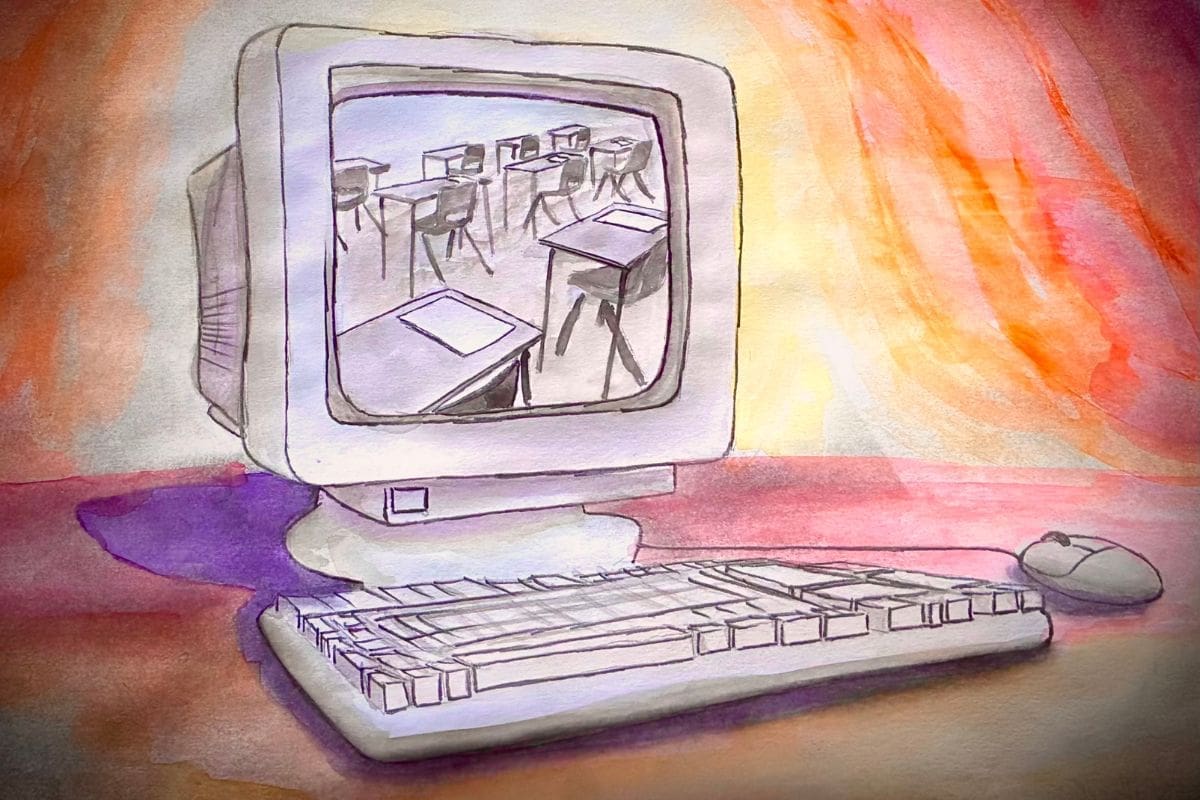
Feature illustration by Devon Stadnyk/The Nugget