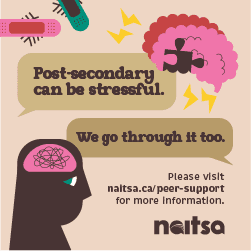
Starting post-secondary often comes with a big question: How many courses should I take? Some students love staying busy and thrive under a full schedule, while others prefer fewer classes to keep stress manageable.
For many NAIT students, their fast-paced two year programs don’t have much flexibility and their courses are chosen for them.
But other programs, like NAIT’s Business Administration diploma or degree, work a bit differently; students can pick classes to suit their needs. And If you’re new to the program, it’s easy to feel lost in the mix of advice and expectations on what, and how many classes, to take. It makes one wonder, is there even a right answer?
A day in the life of two NAIT marketing students
Faustina Ikokwu, a fourth-year Bachelor of Business Administration Marketing student, is carrying a full load of five courses this semester. Her day starts with early trips to campus for a 10 a.m. lecture on Mondays and Wednesdays.
After class, she refreshes her mind with a workout at the NAIT Fitness Centre, then heads home for lunch before her 6–9 p.m. online class. Tuesdays and Thursdays are even busier with two in-person classes, plus another online class in the evening.
On weekends, she switches gears and works as a sales associate, often clocking three to seven hours per shift. Somewhere in between, she balances studying and relaxing in bed.

Milisa Maimon, a second-year Business Administration Marketing student, has taken a different approach.
She’s enrolled in three courses, which gives her a lighter week and more flexibility. Her first class also starts at 10 a.m., so she leaves home at 8:30 a.m., studies for about 20 minutes before lectures and takes careful notes in class.
“Don’t overestimate the amount of time you actually have.”
Afterward, she heads home to continue studying, then unwinds with a gym session before making dinner and calling it a night. Mondays are class-free, Tuesday and Thursdays are packed with back-to-back lectures from 10 a.m. to 2 p.m. and Wednesdays and Fridays are lighter with just one class. On weekends, Maimon trades her notebook for a server’s apron, picking up shifts at her job.
Pros and cons of each course load
For Ikokwu, the hardest part of taking five courses is the group work, which she has in every class. Coordinating meetings among busy peers can be overwhelming, especially when multiple assignments have close deadlines.

She admits, “I’m very thankful that right now, in this semester, I don’t have any math classes, or I would say that math is my hardest.”
Fortunately for Ikokwu, most of her current courses do not require final exams. Plus, the heavier load gives her the chance to catch up after setbacks in her first year.
Initially, she struggled with the course load and even had to retake a class, delaying her graduation. “And because of that, now I’m like, ‘Okay, I want to speed that up. I want to push it quicker,’” she says. By maintaining five classes now, she can accelerate her timeline and stay on track for her adjusted graduation year of 2027.
Ikokwu says the schedule is “kind of” manageable in terms of work-life balance. With most commitments packed into Monday through Thursday, she enjoys some free time on Fridays and weekends.
In contrast, Maimon says, “I don’t think I have hard days currently.”
Still, like Ikokwu, Maimon’s biggest challenge is scheduling group work with classmates, since aligning everyone’s free time can be tricky, even with less classes. The best part of her lighter course load is the flexibility: she enjoys going home early on Wednesdays and Fridays and having no school on Mondays.
Managing their course loads
For Ikokwu, a lighter load of three courses had once felt “like nothing.” She recalls, “I had so much time on my hands, it felt really weird.” Despite her less-than-fortunate first-year experience, she believes she is now equipped to handle five courses and shared some practical strategies for staying on top of deadlines:
- Calendar trick: Ikokwu sets due dates two days earlier than they actually are.
- Clocks ahead: She keeps the time on her devices five minutes ahead to avoid being late.
- Campus resources: Ikokwu credits her turnaround to campus support services. After being placed on academic probation in her first year, she sought help from NAIT’s Learning Services, where she secured accommodations like extra time on tests and permission to record lectures.

Ikokwu also accessed counseling services when she was going through a difficult time, and relied on quiet spaces like the library and the NAITrium to focus. These resources, along with supportive advisors, gave her the confidence to attempt a five-course load again. “I thought I was Superman and I was invincible,” she says. “But you know, I’ve asked for help. I’ve told people this is where I struggle with.”
“Know your limit. That’s know where you excel in, know where you struggle a bit with. And if you do struggle in certain aspects, it shouldn’t be a problem to ask for help.”
Meanwhile, Maimon’s decision to take three courses came down partly to availability. She actually wanted four, but was waitlisted for another class and didn’t end up getting in despite being first in line. At the same time, she explained that her serving job, which she had before starting the semester, was a key consideration. She didn’t want to overload herself and risk losing the ability to keep working.
Unlike Ikokwu, Maimon admitted she didn’t weigh graduation time heavily in her decision. Since she isn’t in a rush to finish, her priority is balancing school and work rather than speeding through her program.
Still, Maimon takes the time to stay organized. She reviews the syllabus at the start of the semester, notes all important deadlines and separates her classes into three folders on Notion. Despite the smaller load, Maimon admits she still sometimes “ends up forgetting the small little assignments.”


The NAITrium and the library are both spots for students looking to study in a quiet space. Photos via Alleah Boisvert / The Nugget
It all comes down to priorities
Ikokwu’s experience demonstrates that while a full course load can be stressful, it’s manageable with strong time-management habits and the willingness to ask for help. Her advice to other students: “I think my best advice is know your limit. That’s know where you excel in, know where you struggle a bit with. And if you do struggle in certain aspects, it shouldn’t be a problem to ask for help.” Burnout, she warns, can take away the joy of learning.
Maimon offers equally valuable advice: “Don’t overestimate the amount of time you actually have.” She advises students to complete assignments before relaxing, while recalling how cramming left her feeling even more stressed. Her perspective highlights that success isn’t just about the number of courses you take, but also about knowing your limits and planning realistically.
Therefore, when deciding on a course load, students should weigh their own priorities:
- Academic goals: Do you want to graduate sooner or pace yourself?
- Work commitments: Do you need time for part-time work?
- Mental health: Can you handle five courses without burning out?
Ultimately, there’s no one-size-fits-all path. The takeaways from Ikokwu and Maimon is that you need to be intentional, whether that means pushing ahead to graduate sooner or slowing down to balance work and life. After all, your course load isn’t just a number, but a reflection of your goals and priorities. Finding a course load that fits helps you build a meaningful, sustainable student journey to graduation.
Feature image via NAIT Content Collective