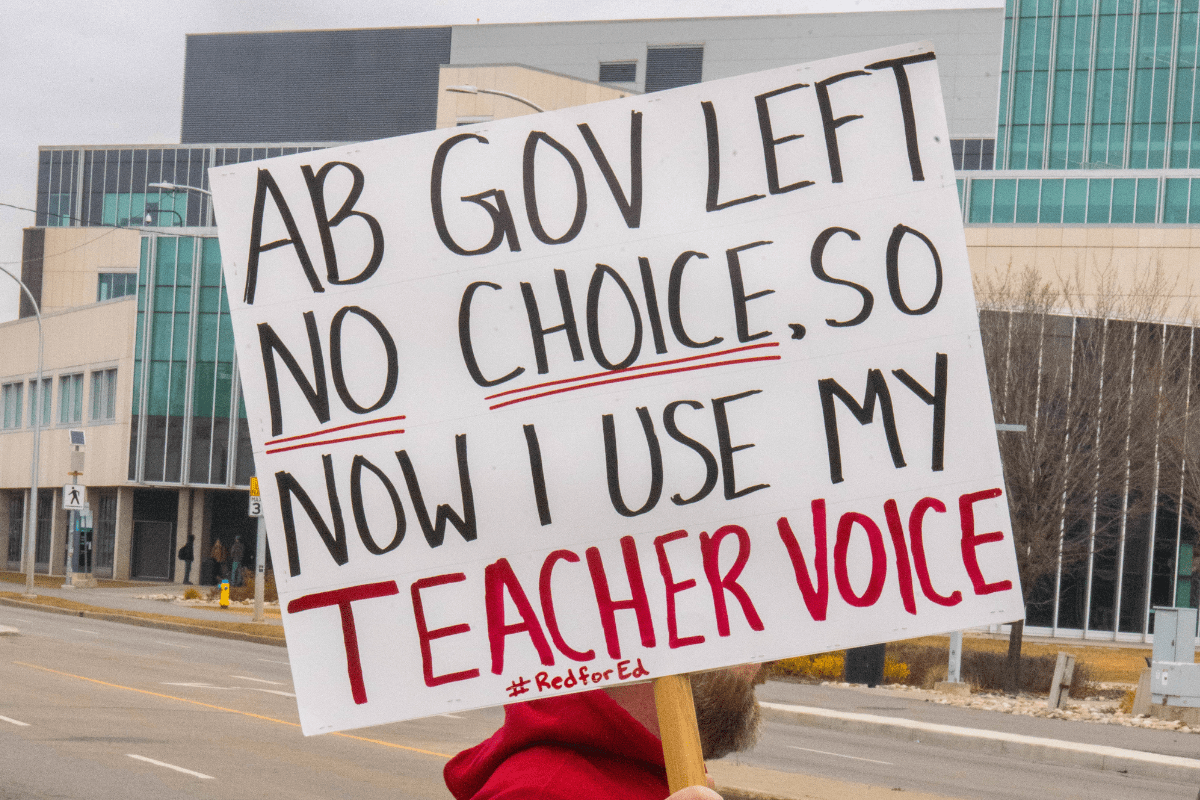
What is all the buzz in Alberta about Bill 2 and the notwithstanding clause? In short, on Oct. 28 the Alberta government (kind of) illegally ordered teachers back to work, but invoked the notwithstanding clause to make it legal. If that sounds confusing, this article breaks down the Canadian Charter of Rights and Freedoms, Bill 2 and the notwithstanding clause.
A refresher on the Charter of Rights and Freedoms
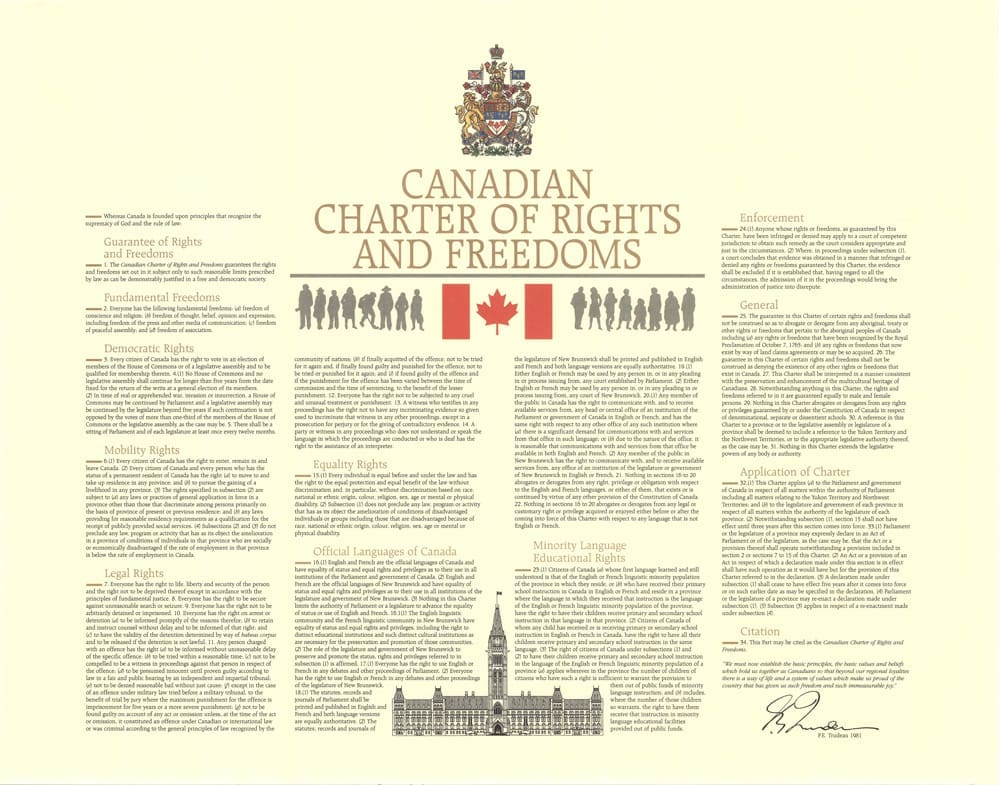
The Canadian Charter of Rights and Freedoms was signed in 1982 and is a part of the Constitution of Canada. It guarantees certain rights and freedoms of Canadian citizens that, in theory, no majority vote can violate.
As a hypothetical example, if a majority of people in Nunavut vote for a party that passes a bill deciding citizens can’t leave Nunavut anymore, that would be in violation of the Section 6 (Mobility Rights) of the Charter of Rights and Freedoms.
The minority of people who didn’t agree to this would have their rights violated.
Thus, that minority of people can take the Nunavut government to court, and the Canadian judiciary, an independent, unelected court that upholds the rule of law in Canada, can find the Nunavut government acted illegally.
Alberta teachers’ strike and Bill 2
To track this onto what’s happening now, the Alberta government passed Bill 2, or the “Back to School Act” on Oct. 28.
From the government’s website, the bill “legislated teachers back to their classrooms on Wednesday, October 29, 2025, by invoking the notwithstanding clause to end the Alberta Teachers’ Association (ATA) strike.”
The teacher’s union went on strike on Oct. 6 for better pay and conditions, and now, the Alberta government has forced teachers back to work with the imposed agreement teachers have previously rejected during bargaining, which is now suspended until Aug. 31, 2028.
If teachers don’t return to work, they can be fined up to $500. Organizations like the Alberta Teachers’ Association can be fined up to $500, 000.
Since a 2015 Supreme Court ruling involving the Saskatchewan Federation of Labour, the Government of Saskatchewan and Saskatchewan’s Public Service Essential Service Act, return-to-work orders have been considered in violation of Section 2(d) of the Charter, Freedom of Association.
However, with Bill 2, the Alberta Government invoked the notwithstanding clause, which (theoretically) protects this violation. Let’s go back to the theory.
What is the notwithstanding clause?
The Constitutional Studies Centre defines the notwithstanding clause as a function to “prevent a court from invalidating a law that violates Charter provisions relating to fundamental freedoms (section 2), legal rights (sections 7-14), or equality rights (section 15).”
In other words, it allows the provincial and federal government to protect a law that violates the Charter of Rights and Freedoms from a court ruling.
In Alberta’s case, the teachers cannot take the provincial government to court for their return-to-work order, which is technically in violation of the Charter.
So, why even have a Charter if there is a clause that can rule against it?
When the Charter of Rights and Freedoms was signed in 1982, the provinces wanted the ability to ignore the Charter if they didn’t agree with a court decision. Remember, the Alberta government was voted in by and represents the Albertan people — you could argue that the courts forcing the Alberta government to be held accountable is an overreach by an unelected judiciary.
Past uses of the notwithstanding clause
In 1998, Alberta attempted to use the notwithstanding clause in the Institutional Confinement and Sexual Sterilization Compensation Act. According to CBC, between 1928 and 1972 the Alberta government forcibly sterilized 2800 Albertans. Alberta had introduced Bill 26 to limit the amount of money given to victims. The bill attempted to invoke the notwithstanding clause, but the Government of Alberta “withdrew the legislation less than 24 hours later in the face of public outrage.”
Alberta also tried to invoke the clause in 2000 with the Marriage Amendment Act, limiting same-sex marriage within Alberta. While the use of the clause was upheld, the act itself was considered unconstitutional, with the federal government arguing Alberta was not allowed to decide on civil unions and marriages. Thus, in 2005, it expired.
Looking at other provinces, Quebec also invoked the clause in 2019 with Bill 21, banning the wearing of religious symbols by public servants. This has continued to hold strong, despite controversy and pushback from national organizations.
What’s next?
Both times the Alberta government failed to invoke the notwithstanding clause was because the legislations were wildly unpopular or unconstitutional.
I believe this time it is neither. While the clause is controversial, Albertans want their children in school and I think much larger rallies by parents in support of teachers may be unlikely, especially now that normalcy is returning for them. As well, legislation on educational matters is within Alberta’s jurisdiction and the government appears to be holding strong in their decision.
In my opinion, the Alberta government’s use of the notwithstanding clause is not only legal, but within the intent of the clause. As such, I think the judiciary could uphold Alberta’s right to exercise the bill, even though the Canadian Bar Association questions the haphazard manner in which it was passed.
If the teachers desire better conditions, they will need to find new avenues of political dissent. This could be appealing to federal involvement, waiting until the next provincial election or calling for support from other unions through labour strikes.

The Alberta Federation of Labour believes this use of the notwithstanding clause could negatively impact other working Albertans in the future. But it will take a lot of advocacy, public pressure and collective organization to challenge Alberta’s use of clause — and only time will tell whether these efforts will succeed.
Feature image by Mathieu Durnford