If you’re anything like me, you may have looked at Alberta’s Oct. 19 referendum and thought, “Wait… what exactly am I voting on?”
There are ten questions covering immigration, voting, the constitution, courts, provincial power and Alberta’s future within Canada. That’s quite a lot, so I spent some time trying to better understand what is being asked of us. I’ve written this article not because I think I have all the answers, but because ten questions that could shape how Alberta operates within Canada deserve more than a quick ‘yes’ or ‘no.’
And I have some questions of my own.
The government has put together explanations for the questions, and I actually recommend exploring them for yourself.
Just remember that these are the government’s explanations of proposals it wants Albertans to consider. Instead of asking, “What is the government telling me?” we should also ask, “What questions aren’t being answered?”
The more that we ask about this referendum, the more ambiguity there is around just how much power we are handing our provincial government.

Who will the referendum impact?
The first five questions focus on immigration, access to provincial programs and voting eligibility. They ask about giving Alberta more control over immigration, restricting access to provincial programs for some non-permanent residents, introducing a 12-month waiting period for certain social supports, charging temporary residents fees for health care and education and requiring proof of citizenship to vote.
These questions affect so many different people, yet we are being asked to make incredibly complex decisions through a binary ‘yes’ or ‘no.’
The government argues that the current immigration system is unsustainable and that Alberta needs more say in who can enter as a temporary or non-permanent resident.
There’s legitimacy in asking how temporary residents contribute to Alberta and public services, but I keep coming back to the people behind those categories.
What happens to the people who are already legally living, working and raising families here? What happens to industries that currently rely on temporary foreign workers? Will we be creating unnecessary hardships for people already contributing to Alberta? Who are we to blame them for problems with our deliberately underfunded public health care and education systems? Why turn against people we welcomed to our province within the last decade, and why now?
How much power should the province have?
Questions six through nine propose constitutional changes involving the appointment of provincial judges and abolishing the Senate. They would also allow provinces to opt out of federal programs without losing associated funding and give Alberta’s laws priority when they conflict with federal laws. A ‘yes’ vote wouldn’t be an automatic change; the Alberta government would be required to work with all other provinces to amend the Constitution.
Taken individually, these might sound like four separate issues. Taken together, I think they reveal something much bigger: How much power should Alberta have to govern itself?
And that brings us to separation.
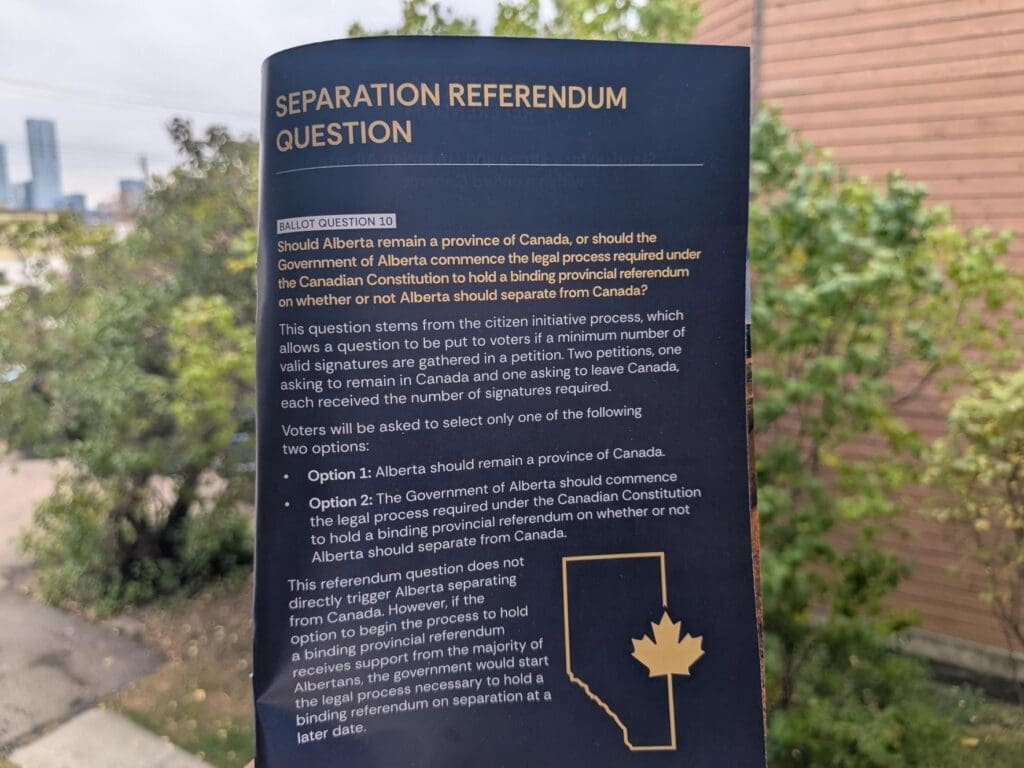
Only Question 10 directly asks whether Alberta should remain a province of Canada or start the legal process towards a binding separation referendum.
While a ‘yes’ to this 37-word question would not separate Alberta from Canada, there are enough arguments against it and questions unanswered that even our provincial government and Premier Danielle Smith describe their position as “building a stronger and more sovereign Alberta within a united Canada.”
Granted, a similar statement of support to remain didn’t go as intended for the United Kingdom when it came to Brexit exactly ten years ago. It’s a reminder that statements about political outcomes can look very different once voters are actually asked to make a decision.
Who will be holding Alberta’s microphone?
While the other nine questions aren’t technically separation questions, they are questions about provincial autonomy within Canada. They ask whether Alberta should have more authority, more control and more ability to act independently of the Canadian government. That distinction matters.
When we ask for substantially more provincial power, we also have to ask what that power looks like when we disagree with the government holding it. A stronger Alberta voice in Canada is one thing; giving the Alberta government more power is another.
I believe Alberta’s voice deserves to be heard. But we should ask, “Who do we want holding the microphone?”
The United Conservative Party has held that microphone for seven years, but governments change. The powers we give to one government today can be exercised by a different government tomorrow.
The consequences could be complex, and caution is warranted
These are the thoughts that keep running through my mind. And honestly, I don’t feel comfortable giving a ‘yes’ when so many details remain unanswered. A ‘yes’ is more than saying, “I like the idea of this.” It is giving our government a mandate to act on those ideas. If I’m going to hand my government that kind of authority, I want to understand its intentions, its limitations and its consequences.
The powers we give to one government today can be exercised by a different government tomorrow.
For me, that means being cautious. I don’t want to give a blind ‘yes’ to something this broad and complex because the ballot makes the decision look simple. But that’s where I believe my responsibility lies; for you, it might be different.
Vote, and vote responsibly
In this referendum, Alberta is sending a message to Ottawa, other provinces, newcomers, Indigenous peoples, students, families, businesses and even the rest of the world about what kind of province we are and want to be. These questions affect so many different people, yet we are being asked to make incredibly complex decisions through a binary ‘yes’ or ‘no.’
That doesn’t mean we shouldn’t vote. It means we should take the responsibility of voting seriously. Research. Learn what you can. And then vote. Your voice matters and democracy doesn’t require us to agree; it requires us to participate.
Visit Elections Alberta for all Referendum Election Day voting information.
Feature image graphic by Alleah Boisvert/The Nugget