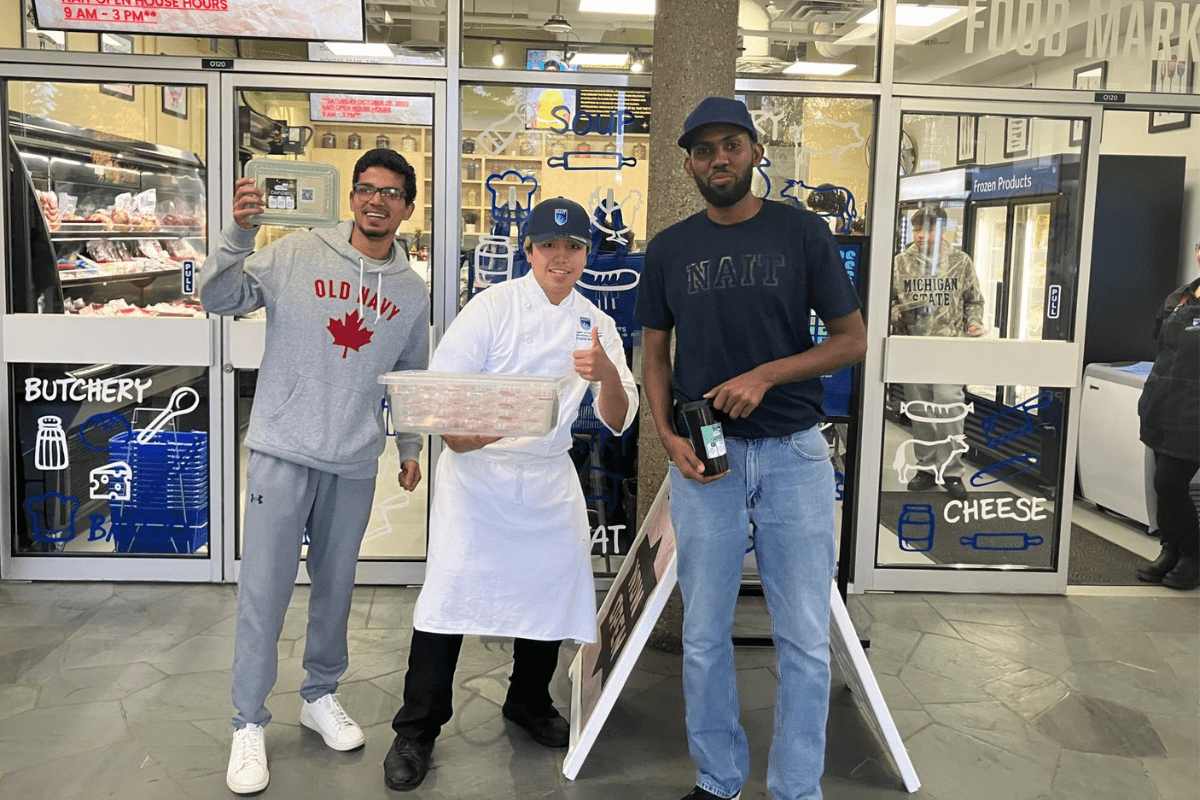
For those that regularly visit NAIT’s Artisanal Food market, a new container has appeared on the shelves, with a message to return once done so it can be reused. But the sustainable endeavour didn’t start with NAIT — rather, it’s a capstone project from four Bachelor of Technology students that’s grown into something bigger.
The management students are currently working with DishZero, a sustainability-focused non-profit.
Andy Do, Yaksh Bhardwaj, Ahmed Maalim and Taylor Van Velssen were given options by their instructor for the project to take on realistic industry challenges presented by industry sponsors.
“We were to choose the ones that we most affiliated with. And then from there, they assigned us to the ones based on our backgrounds,” says Do.
On its website, DishZero describes itself as “an Edmonton-based nonprofit that offers reusable takeout containers and mugs to participating vendor locations.” The initiative was the result of a 2023 merger of two student-led sustainability programs at the University of Alberta (U of A). DishZero’s overall goal is to “reduce the single-use waste associated with takeout dining.”
Initially partnering with businesses within the U of A, the non-profit has since expanded to businesses outside of the university — including the NAIT Artisanal Food Market.
NAIT students have worked with DishZero before, but this is the first time students have implemented the program within NAIT.
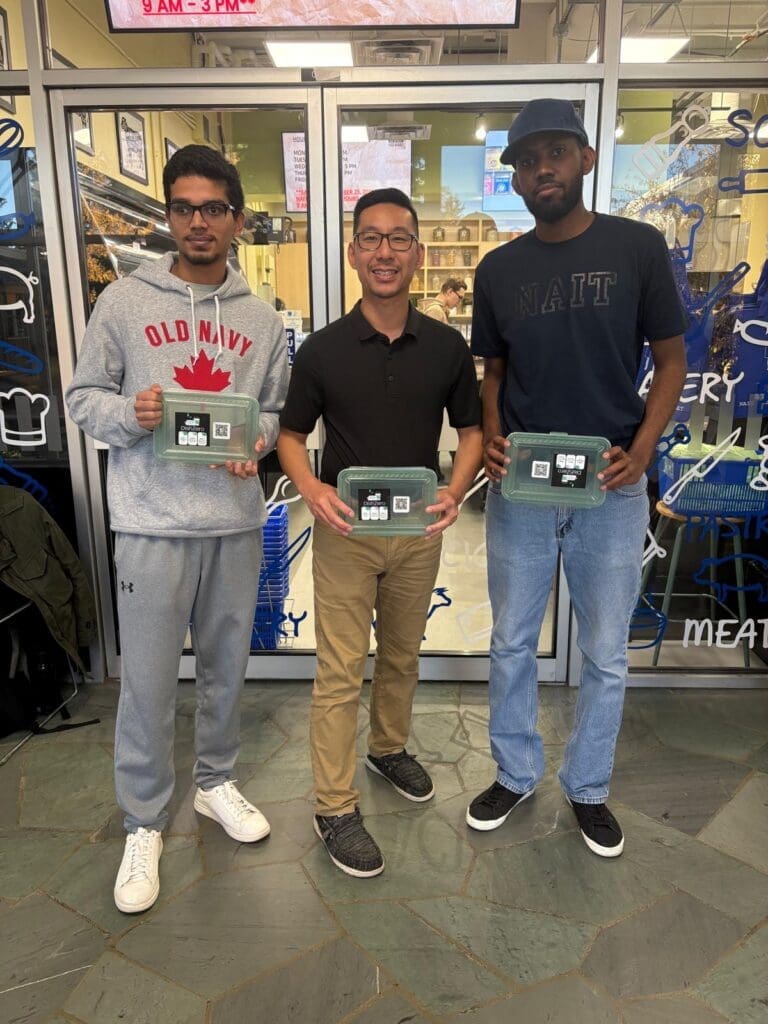
The DishZero containers are pre-packed with food from the Artisanal Food Market. “You go there and you take those containers with the food. There is a QR code on every dish. You scan that, you sign it out, and then they know that this [container] is used by this person. And then after eating your food, you go back,” says Bhardwaj.
The containers are dropped off at designated bins, then cleaned by NAIT Artisanal Food Market staff before being used again.
According to Do, initial figures were encouraging. “We were surprised,” he says. During the first two weeks of the program’s implementation, the student group saw a 100 per cent return rate. DishZero’s target is to prevent 20 per cent of containers from being thrown away, Do explained.
“At that point … we had about 50 to 60 dishes lent out,” says Do. “Considering that there was no losses, aside from two damages, we were actually really impressed with it.”
The DishZero containers are built to withstand 1,000 uses, making them ideal for reuse.
“The point is really to have something that’s a little bit better quality than what we’re used to. Because we’re used to just getting those plastic containers that, once we’re done, we maybe use it personally once or twice and then throw it out. The idea of this is to have that commercial reuse,” says Do.
While the Artisanal Food Market does the actual handling of the reusable food containers, Do’s group has a two-phase role in the program’s implementation. During the fall term, their role was to launch the program, promote it to the NAIT community and monitor its progress. Now that the winter term has begun, they are shifting their efforts towards actual sustainability, which is the second phase.
Bhardwaj clarified that throughout the past term, there was no added cost to the buyer to use DishZero products. “But in the future, we have to make it sustainable for the non-profit organization so that it should be a long-term thing. So for that, we have to come up with the pricing model that we are working on,” he explained.
The students also act as consultants to DishZero and the Artisanal Food Market. This involves exploring other suitable on and off-campus businesses the program can be implemented and suggesting ways to make implementation at the market smoother, like analyzing if there is a need for more strategically placed return bins.

Do shared that the staff at the Artisanal Food Market have been very supportive of the program. “The staff have been really good at helping us out with the education piece to the people that are purchasing, as well as trying out for themselves and putting in suggestions where necessary,” he says.
Both Do and Bhardwaj are personally invested in sustainability and encourage NAIT students to participate in the DishZero program.
“Sustainability is something that we need to work for. We know it’s the right thing to do, so the challenge is to change our behavior, and that’s always going to be the hardest thing because we’re going from something that we’re used to, to doing something that we’re not,” says Do.
Bhardwaj agreed, offering a practical suggestion for improved sustainability.
“It takes time to change our behavior, to step into something which is new for us, but if we cannot go for a big thing, just try to do or go with small steps.”
Feature photo supplied