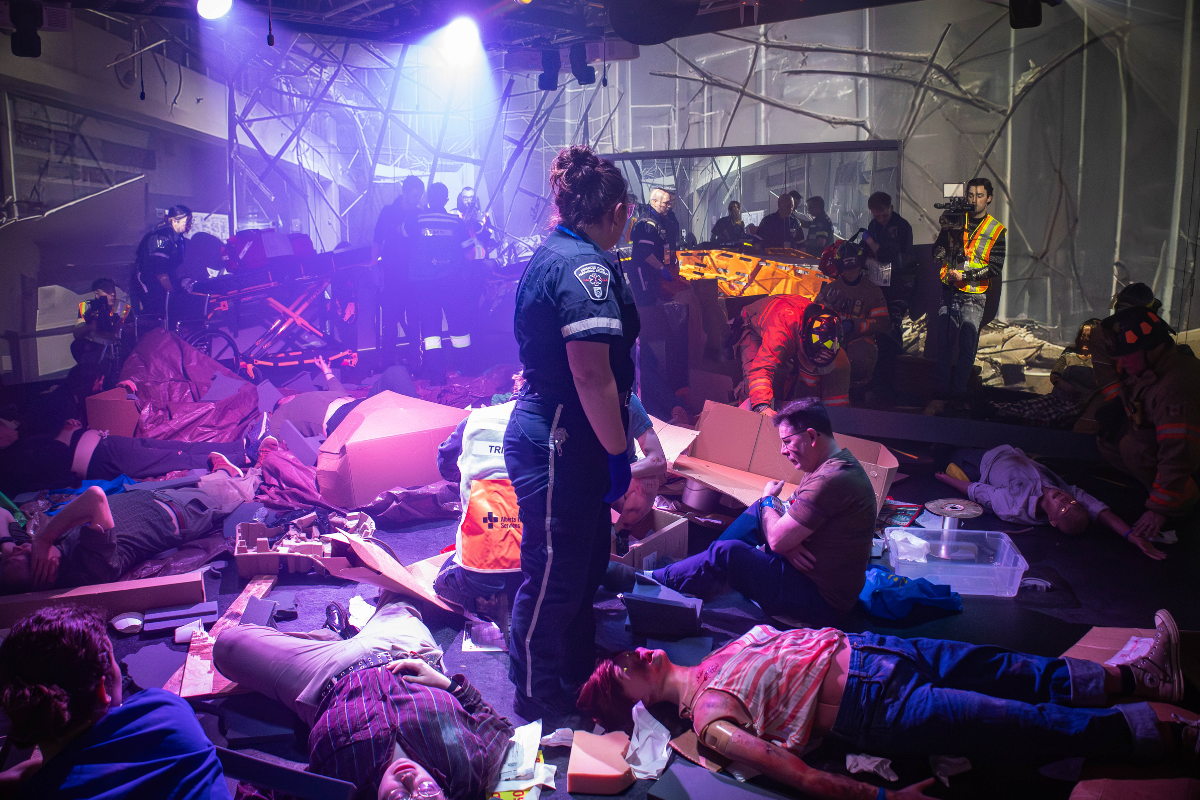
When students at NAIT’s Centre for Advanced Medical Simulation (CAMS) hear “simulation start” over the intercom, they are transported from the classroom to a disaster scenario. At the scene, students encounter injured patients, blood, yelling, smoke and debris; an immersive simulation of a building collapse to apply their learnings.

It’s all part of a planned, full-scale mass casualty simulation NAIT hosted on March 28. The simulation was also open to students representing 10 medical programs across SAIT, University of Alberta, University of Calgary and NorQuest College. Over 115 student participants worked together, transporting patients from the scene to CAMS’ hospital care facilities and administering care to injured patients, ranging from routine first aid to MRI examinations.
“There’s a part of your brain that just completely dissociates and you get super focused in on what you’re doing and what your task is, just like the real world.”
Terry Schlitter, Dean of NAIT’s School of Health and Life Sciences, says this is the third year CAMS has run the simulation.
“Our goal is to create a mass casualty incident that is mimicking real life,” says Schlitter. In order to re-create these realistic scenarios, CAMS had NAIT Disaster and Emergency Management students involved in planning last year.
“So that complexity, that pressure, the students will feel the same way they feel in a real incident when they’re out there in the workforce.”
The scene was intense and believable, with a range of trained actors in “full-on makeup” reacting how they would if they had a serious injury — the simulation even had different trauma cases students had to treat.
Maya Lindell, a second-year Advanced Care Paramedic student, acted as a student facilitator during the event. Lindell has experience working as a primary care paramedic in Edmonton and says these simulations are “actually quite realistic.”
“There’s a part of your brain that just completely dissociates and you get super focused in on what you’re doing and what your task is, just like the real world,” says Lindell.

Jennifer Simpson, a second-year Magnetic Resonance Imaging (MRI) student, was also at the simulation to help first-years prepare for clinical experiences. At this point, the MRI students have only experienced didactic teachings — theoretical teachings through class instruction.
“It was very cool to see our first-year students actually get to apply their skills that they’ve learned through didactic for the first time,” says Simpson, who worked with the students during weekly patient screening and safety labs. “To see that come full circle where they actually had to apply that knowledge I had been working with them in labs is great.”

Though the mass casualty simulation provides the junior students with opportunities to work through realistic emergency triages, it is also a way for students to connect with each other before entering the industry.
Lindell says the most memorable part of simulations was recognizing students outside of school after a previous simulation event.
“I was still guiding the Primary Care Paramedic students, and then later on seeing them in the real world at hospitals and me recognizing them or them recognizing me, and just having that little bit of connection despite us never having actually worked together,” she explains.
In a real hospital, medical doctors, nurses, x–ray and MRI techs, lab techs, medical assistants, respiratory therapists and paramedics work as a collaborative healthcare team. The goal is for the students to build interprofessional, intercollaborative skills.

“It really does enhance the patient outcomes positively when students are able to work in that interdisciplinary team effectively,” says Schlitter.
Schlitter, a NAIT alumna, is proud of the work NAIT programs have done with CAMS to make the simulations a safe — but intense — environment for students to build confidence before entering their careers.
“Once they get out there and they actually encounter a real mass casualty, they are prepared. They know what to expect. They know what their role is within that health care team, and they can jump right in,” Schlitter says.
For more information about NAIT’s Centre for Advanced Medical Simulation and its capabilities, visit their website.